

The importance of rainfall ingress
As reservoirs age there is an increased risk of rainfall ingress into the reservoir, this is caused by the roof and lining of the reservoir degrading over time, to the point where water is able to seep through and into the water. This indicates which reservoirs are most in need of maintenance to assist in asset planning and management.
How to look for rainfall ingress
This process is a little more complicated than a simple linear relationship between rainfall and turbidity. Because the reservoir has earth on top of it, this is capable of absorbing some of the water, once this is saturated, the rainfall can start to seep into the reservoir. The quantities of water involved in the reservoir also play a part in the response, if there is a lot of water in the reservoir then the rainfall is more heavily diluted and there is less of a response. Although it is possible to see the trends on the graphs below, for ease of analysis, we have developed tools to automatically assess reservoirs for risk of ingress.
What sensors are needed
In order to detect this, we use the turbidity measurement as it is least affected by the source water and is capable of picking up minute variations, not visible to the human eye. You will notice that the scales on the graphs below are only up to 1 NTU, and the variations we are looking at would be in the noise-floor of most sensors – this is where the Intellisonde is best suited for this task as we have spent many years improving our turbidity measurement to ensure it is as sensitive as possible. This is also where in-pipe methods excel as the turbidity measurement is taken within the water itself so has no risk of missing particles due to sedimentation effects or causing incorrect conclusions due to a time delay
How this can be done in Insight
Our Insight platform enables us to take in data from many different sources, this unlocks analysis that would otherwise be difficult and time-consuming. In this case, we have access to all the rainfall data from over 900 monitoring stations across the UK. We have therefore managed to find stations within a few miles of each reservoir. By plotting the rainfall next to the turbidity measured at the outlet, we can assess which reservoirs suffer from ingress.
The findings
Analysing 7 reservoirs we discover that 2 exhibit visible ingress problems. There reservoirs will hereby be referred to as: Reservoir A and Reservoir B
Reservoir A
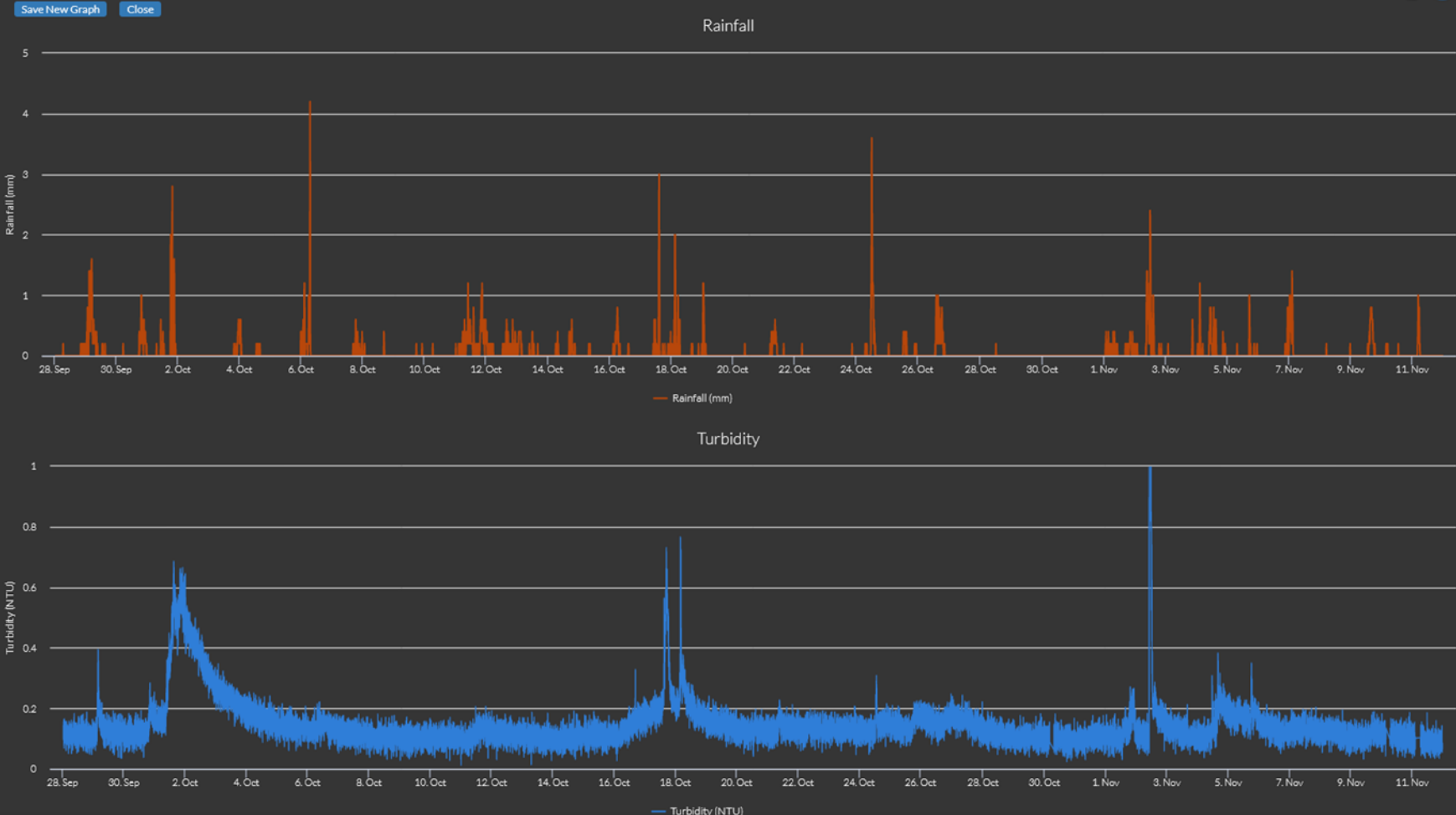
This site seems to show the most response to rainfall. You can see that the complexity of the relationship means that sometimes there is a lot of rain but little response, this is due to unsaturated ground or high reservoir levels causing a delayed or diminished response. It was mentioned to us at the start of the project here that there was a concern about rainfall ingress, so this data backs up those concerns
Reservoir B
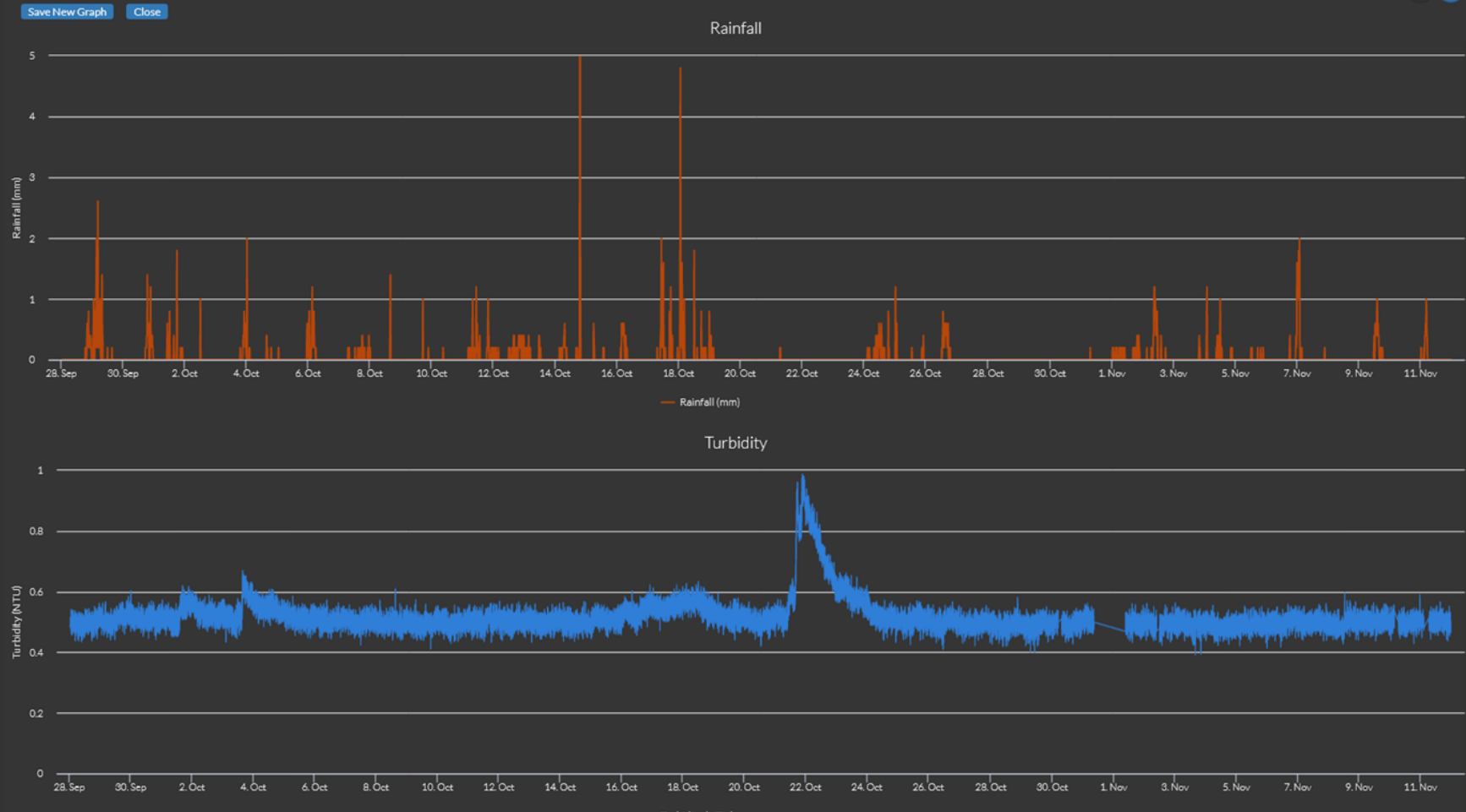
There is somewhat less of a response at Reservoir B but there does seem to be small fluctuations in line with the rainfall. This suggests that although it is not as degraded as Reservoir A, there is still some cause for further investigations as to the state of the lining and whether ingress is becoming an issue.
Summary
As this analysis is a proactive approach to maintenance, we are often looking for small responses to indicate a developing risk and a need for maintenance in the near future, this requires stable and sensitive monitoring via our Intellisondes and an intuitive visualisation through our Insight platform. With this analysis the maintenance can be planned in advance, reducing impact and cost.
Rain Ingress at Reservoirs
As detailed in the previous article (see Reservoir A) during November a customer’s reservoir saw changes in turbidity due to rain water ingress. Since then we have been informed that the customer undertook maintenance work, that concluded early December, to reline the reservoir roof to fix this issue.
October/November
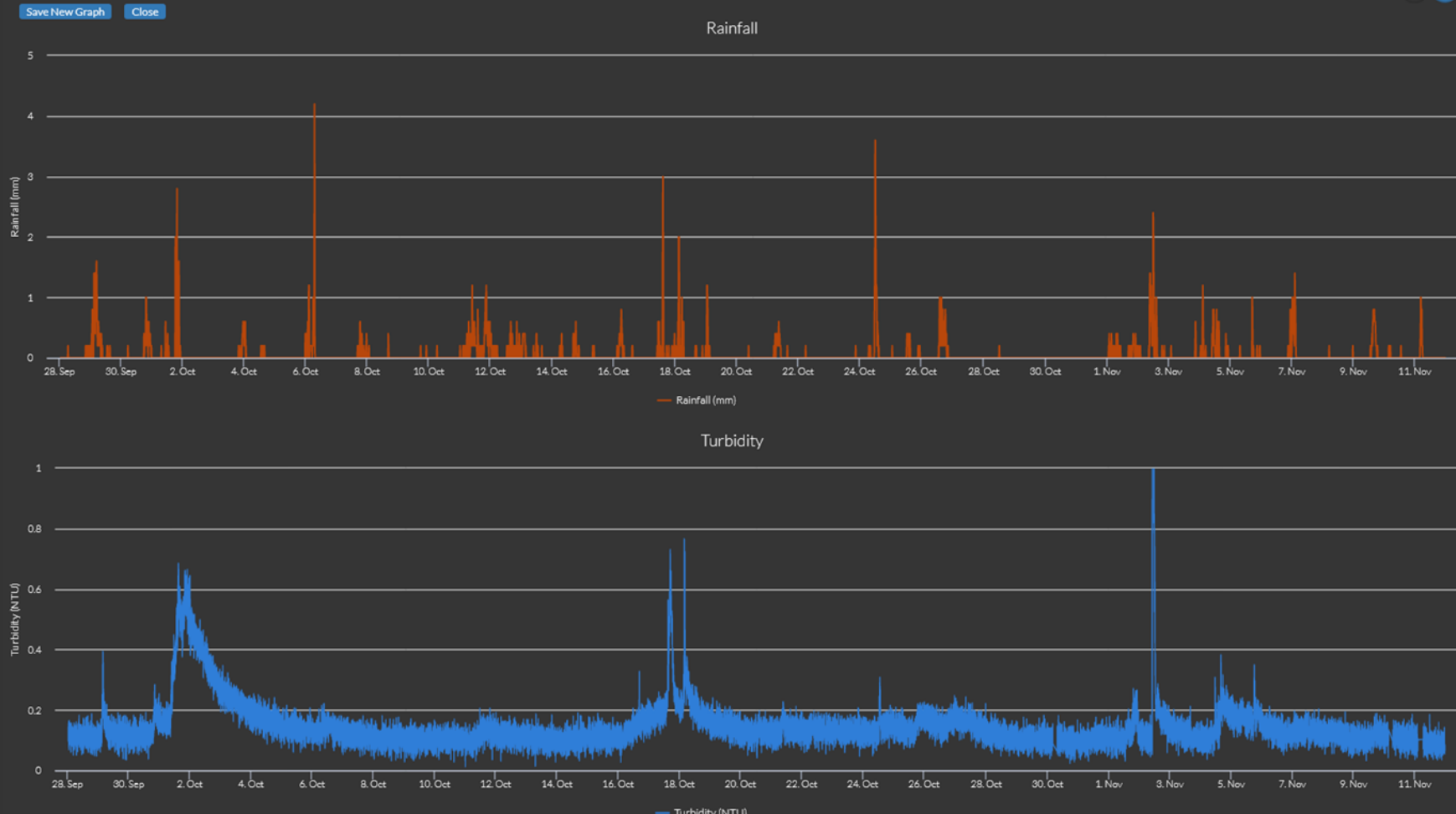
Throughout October and November, we can see that the turbidity shows a complex response to rainfall. Sometimes there is a lot of rain but little response, this is due to unsaturated ground or high reservoir levels causing a delayed or diminished response.
October/November
Throughout October and November, we can see that the turbidity shows a complex response to rainfall. Sometimes there is a lot of rain but little response, this is due to unsaturated ground or high reservoir levels causing a delayed or diminished response.
December/January
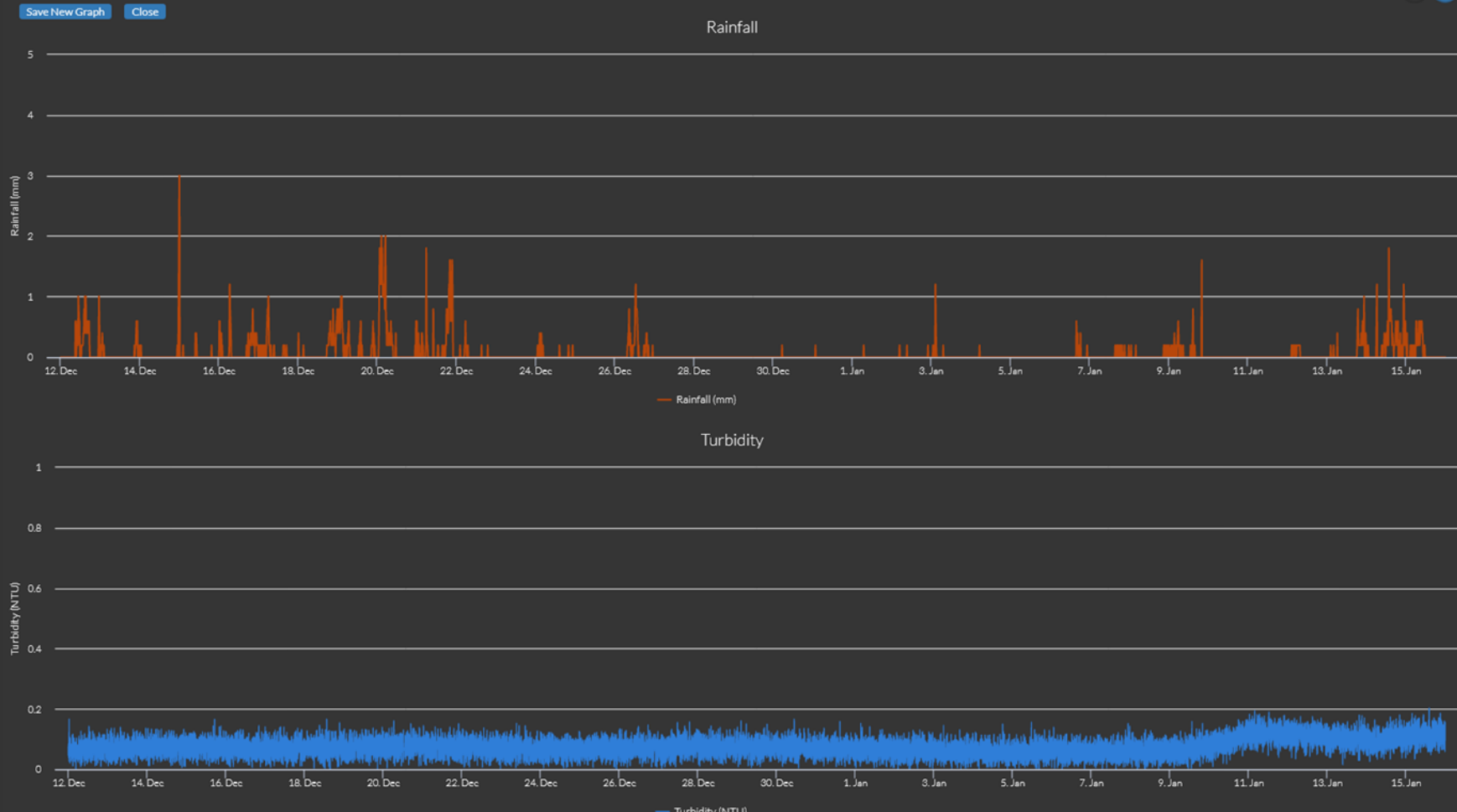
In December and January, the story appears to be very different. There is a lot of rain fall seen at the start of the month but no response in turbidity. The change towards mid-January is unlikely to be due to ingress as it is preceded by a number of dry days and only a small amount of rain fall is observed.
In December and January, the story appears to be very different. There is a lot of rain fall seen at the start of the month but no response in turbidity. The change towards mid-January is unlikely to be due to ingress as it is preceded by a number of dry days and only a small amount of rain fall is observed.
Summary
It would appear as though the customers maintenance work has worked and that this reservoir is no longer seeing water ingress.
Our Sensors
Take a look at our state of the art Chlorine and Turbidity sensors.
One device. One installation. One maintenance point.

Insight App
The Akubic Insight water network management platform allows users to monitor water quality hotspots, event detection, leakage rates and much more.

Our experience with water
We are committed to supporting our customers deliver safe high quality water and making it available everywhere.